
Look Up Wake Forest Neighbors
The public record around a Wake Forest address has several distinct layers. County mapping and property records describe parcels and assessed ownership. The Register of Deeds records the land trail. Voter material concerns registration and is limited by law. Town community resources identify organizations and public ways to participate, rather than a private contact list. Start with the narrow source that answers the actual block question.
| Source | What It Shows About a Block | Access |
|---|---|---|
| Wake iMAPS | Parcel geometry, roads, property information, and adjacent parcels | Public county map and property viewer |
| Wake property search | Assessed owner, REID, PIN, situs and mailing fields | Public county property portal |
| Wake Register of Deeds | Grantor, grantee, deed type, date, book/page, legal description | Online index, counter, and written request path |
| North Carolina voter tools | Registration details and public data fields subject to protection rules | Name/status lookup and official data routes |
| Town Community Council | Participating civic, social, service, educational, religious, and business organizations | Public Town pages, not a member-address roster |
Official sources give a reader a traceable record, a date, and a custodian. Commercial neighbor-lookup products can combine inferred or stale data and may join the wrong people to an address. Compare a questionable result against the county or Town source before retaining it.
| Official record route | Commercial neighbor-lookup category |
|---|---|
| Shows the source office, record type, and access limits. | May merge public and commercial data with unclear timing or matching. |
| Lets the reader check a parcel, document, or map directly. | Should be treated as a lead, not confirmation of a person or block. |
| Has an office or records-request fallback when an online result is incomplete. | Does not replace correction or verification with the government custodian. |
Map Wake Forest Neighbor Parcels
Use parcel geometry to define the immediate block before looking at any names. Wake iMAPS searches by owner, address, place of interest, or intersection, then opens a property-information pane for a selected parcel. The Town's boundaries service adds municipal layers for Town Limits, Jurisdiction, Easements, and Town Owned Property. Together, the county and Town sources distinguish an abutting parcel from a mailing-city assumption.
- Search the starting address in Wake iMAPS and confirm the physical parcel.
- Zoom to the polygons that share a boundary or road edge, then save each REID or PIN and the visible jurisdiction.
- Open each parcel's Wake property card and keep the assessed-owner, situs, mailing, and deed-reference fields separate.
- Use the Register of Deeds only when a parcel's recorded land history is relevant, then check the legal description against the parcel key.
Open the Wake Forest GIS boundary layers when the Town jurisdiction needs confirmation.
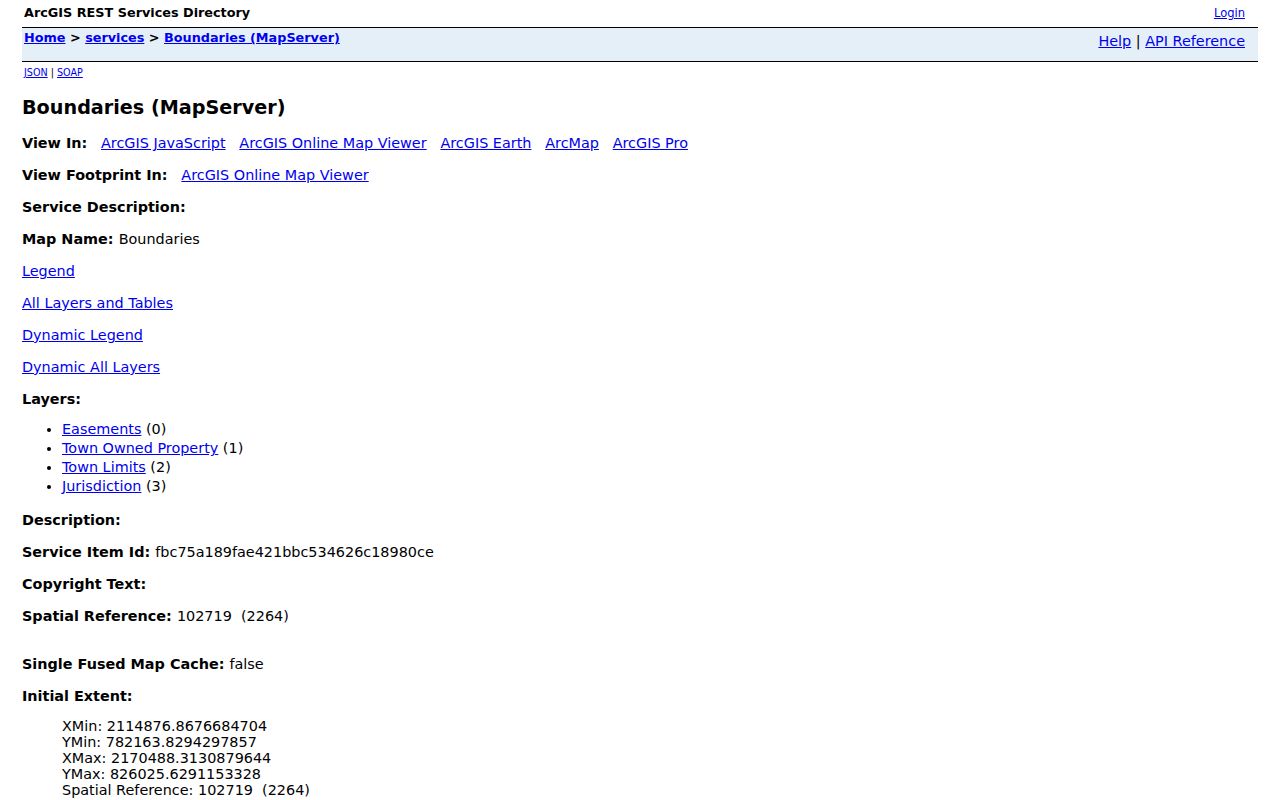
These Town layers establish municipal context. They do not identify social relationships, current household membership, or a right to contact people whose parcels happen to touch.
For a full named-street trail rather than an immediate block, use the Wake Forest street directory.
Compare Wake Forest Block Cards
Repeat the same field check for every adjacent parcel. The Wake property search accepts owner, Real Estate ID, Location Address, and PIN modes. Its address mode uses street number and street name, with the street type omitted from the Street Name entry. Record the results exactly as displayed. A property card can link an owner field to a parcel, but it cannot prove that the owner is the person currently present at the situs address.
Keep the REID and PIN with the situs address, mailing address, owner field, and deed book/page. The first two identify the parcel and its official correspondence route. The owner field identifies the assessed owner or entity, and the book/page is only a starting reference for a recorded-document search.
Do not collapse those labels into a single home-address field. A mailing address may be elsewhere, an entity may own land, and the land record can use a legal description that is more durable than a street label.
Note: Save each parcel key with its source date to keep adjacent results separate and reproducible.
Check Wake Forest Neighbor Jurisdiction
Wake Forest's town boundary matters on a block-by-block basis. Most of the incorporated town is in Wake County, but the incorporated area includes a smaller Franklin County portion. A postal city does not decide which Register of Deeds, assessor, clerk, or elections board holds the local record. A map result near the county line should send the searcher to the county where the land lies, not to the office suggested by the mailing city.
The Town's annexation information explains that petitions use property-owner signatures, metes-and-bounds descriptions, and a plat. That record trail can explain why a historic town or planning file does not match an older rural-township deed.
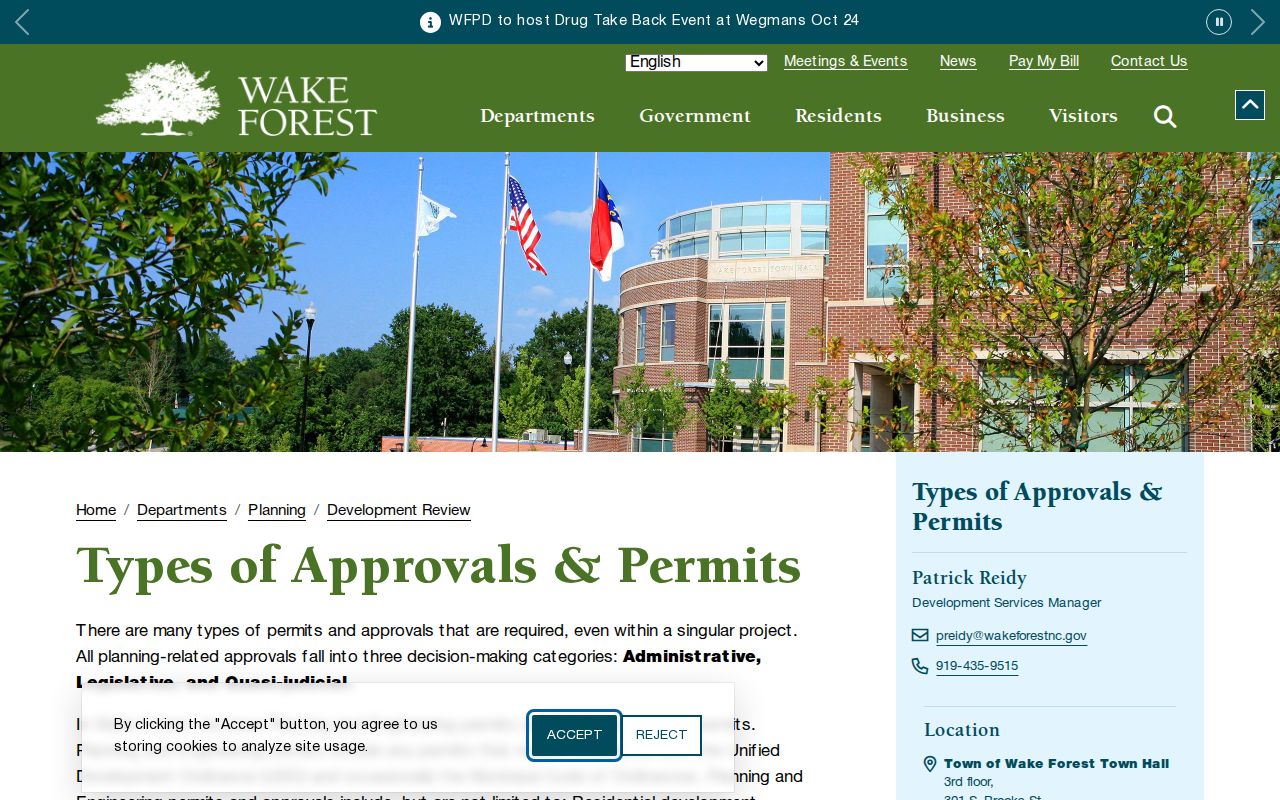
Annexation changes municipal record context without changing the wording of an earlier deed. Save the source date with every boundary conclusion, especially when comparing historical and current blocks.
Note: A Wake Forest mailing address is not enough to choose a county records custodian.
Trace Wake Forest Block Deeds
Adjacent parcels often share a subdivision or plat name rather than a simple street description. In the Wake Register of Deeds index, begin with the property-card owner, book/page, grantor, grantee, or date. The index offers Standard and Sounds Like modes and permits document-type searches. Match the resulting legal description and parcel details before treating two documents as the same tract.
DEED, MAP, SUBN, and EASMT are particularly useful document categories for a block. The menu also includes GRAVE REMOVAL, HIGHWAY MAPS, and VARIANCE, a local reminder that land history can involve transportation, plats, cemeteries, and easements as well as conveyances. A deed of trust or release belongs in the file as an encumbrance event, not a transfer of ownership.
If the online index is thin, the Register of Deeds counter and recorded-document request form are available access channels. Provide a parcel ID, book/page, address, name, and date range rather than asking the office to construct a broad neighbor list.
Read Wake Forest Voter Limits
The state voter lookup is a name and status tool, not a reverse-address system for Wake Forest neighbors. Its fields are first name, middle initial, last name, year of birth, county, and at least one status selection. Choose Wake or Franklin only after confirming the residence county. A matching result may report registration details, jurisdictions, polling place, sample ballot when available, absentee information, and voter history.
Wake County publishes voter-data spreadsheets by precinct group, and statewide registration files can contain address, county, precinct, status, party, and district fields. Those official data routes have update cycles and exclusions. Voter history shows participation information, not ballot choices. Full or partial Social Security numbers, dates of birth, driver-license data, and other protected information are not public through those files.
North Carolina protects qualifying voter addresses, including address-confidentiality participants who follow the required authorization process. Do not use a result to infer a protected location or describe a block as a complete neighbor list.
Find Wake Forest Community Ties
The Town Community Council is a useful affiliation index, not a directory of where people live. It is an autonomous organization of civic, social, fraternal, service, educational, religious, and business organizations and interested individuals. The Town lists participating organizations and representatives. Use that public list to find a historical, civic, or volunteer connection, then direct any inquiry to the organization rather than trying to derive a private address.
See the Town's Community Council overview for its purpose and participation details.
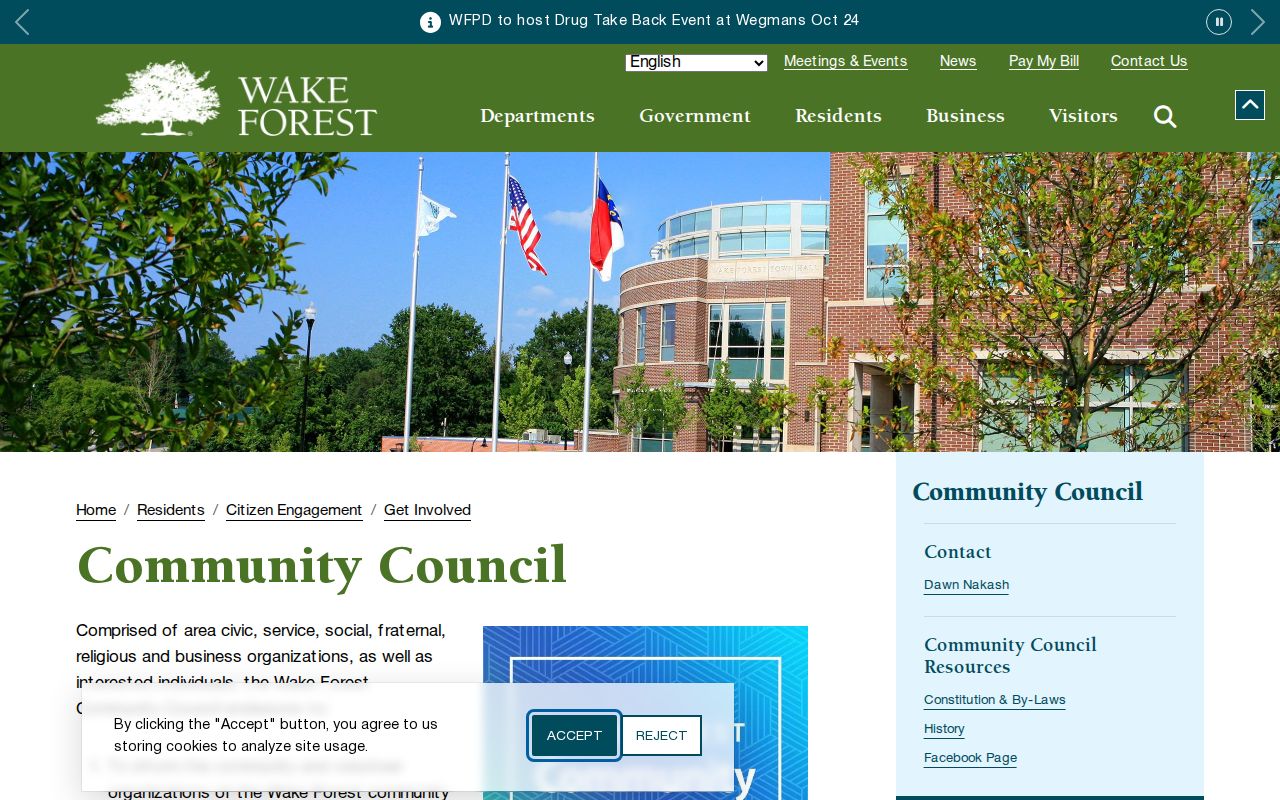
The Community Council supplies a civic connection layer for Wake Forest neighbors. It does not establish that a participant lives near the searched parcel.
| Community source | Examples named by the Town | Appropriate use |
|---|---|---|
| Service and civic organizations | Kiwanis Club of Wake Forest, Optimist Club of Wake Forest, Rotary Club of Wake Forest, Wake Forest Lions Club | Find public organization context or a historical referral. |
| History and culture groups | ARTS Wake Forest, Wake Forest Historical Association, Wake Forest Garden Club, Graham Johnson Cultural Arts Endowment | Locate public events, collections, or local-history context. |
| Community support groups | Northeast Community Coalition, Tri-Area Ministry Food Pantry, Senior Information Networking Group, Wake Forest Center for Active Aging | Use the organization’s own public route for community information. |
| Downtown and school connectors | Wake Forest Downtown, Inc. and Wake Forest Elementary School Foundation | Check public activities and place-based community context. |
The Community Council member list is the source for those organization names.
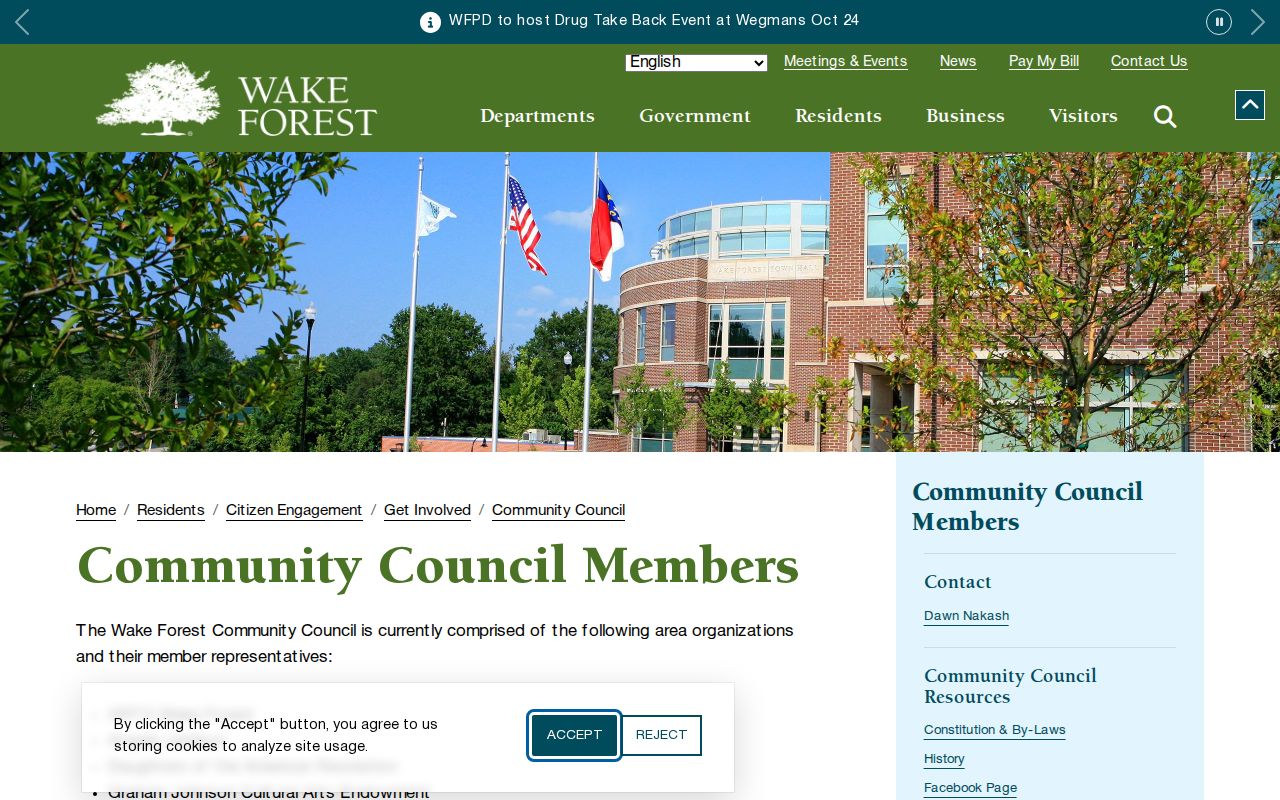
The Town list can guide a focused historical or civic inquiry. It does not publish a complete association roster, private member addresses, or block contacts.
Use Wake Forest Civic Channels
For current neighborhood information, the Town's communications page offers E-Notifier, the weekly “What's Up in Wake Forest,” meetings and news releases, WFTV 10, and a partnership with Nextdoor for neighborhood communication and virtual neighborhood watch. These are public information channels. They are not a public membership roster and should not be used to identify or track residents.
Review the Town's communications channels for official notices and public meeting information.
Public notices can explain a project, meeting, or community activity near a block without turning those notices into a private neighbor record.
The Volunteer Wake Forest route connects residents, families, community groups, and Town departments to public opportunities and advisory boards.
Use volunteer and advisory-board information to participate through published channels. It does not identify which people live on a given parcel.
Note: Public civic channels can explain local activity, but they do not establish membership or a residential connection.
Limit Wake Forest Neighbor Lookup
A neighbor lookup cannot reveal a complete household. Parcel records show assessed ownership and land fields. Deeds show recorded transactions. Voter data follows election rules and can protect addresses. Community pages describe public organizations rather than private membership data. Vital records, sealed court material, protected addresses, and confidential identifiers remain limited even when other government records are open for inspection.
When an online source does not answer a narrow question, retain the map key, record date, and source office. Then use the Register of Deeds counter, Town GIS or Planning contact, County records-request route, elections office, or library archive that maintains the specific record. Do not broaden a parcel check into a dossier.