
Wake Forest City Directory Collections
Wake Forest does not have a verified, separately titled run of printed city directories in the official catalog. The strongest local route is the Hill Directory Company’s Raleigh, North Carolina Suburban Directory, which begins in 1975 and explicitly includes Wake Forest. The Wake County Public Libraries catalog record lists recent issues at Olivia Raney Local History through 2026 Vol. 1. Several are marked noncirculating, so a catalog result is a shelf and access clue, not a promise that the book can be checked out or read online. Compare more than one annual issue before treating a listing as a lasting address.
| Collection | Years | Where Held | Access |
|---|---|---|---|
| Raleigh Suburban Directory, Hill Directory Company | 1975-present, cataloged local issues through 2026 Vol. 1 | Olivia Raney Local History | Some copies are noncirculating; inspect catalog copy status |
| Raleigh city directories, including Polk, Hill, Maloney, and Wills-Smith titles | Selected 1880-1938 editions and later holdings | Olivia Raney catalog | Catalog and local-history access |
| Maloney’s Raleigh directory | 1899-1900, volume 4 | DigitalNC and Internet Archive | Scanned pages, OCR, and PDF access |
| Wake Forest College yearbooks and directories | Selected years from 1912 through 1976 | Olivia Raney Local History | Library use only |
| Wake deeds and reconveyances | Cataloged runs include 1785-1946 and reconveyances from 1884-1939 | Olivia Raney microfilm and fiche | Ask staff for the correct series |
The collection dates are uneven by design. A Hill volume is the documented Wake Forest route after 1975, while an older Raleigh book can supply context for a school, business, or family connection. Neither one should be treated as a complete roll of everyone in town. Note: Record the edition, page, and whether a listing names an occupant or a business before making a historical conclusion.
The suburban-directory catalog record displays the local serial and copy information used to begin a Wake Forest city directory search.
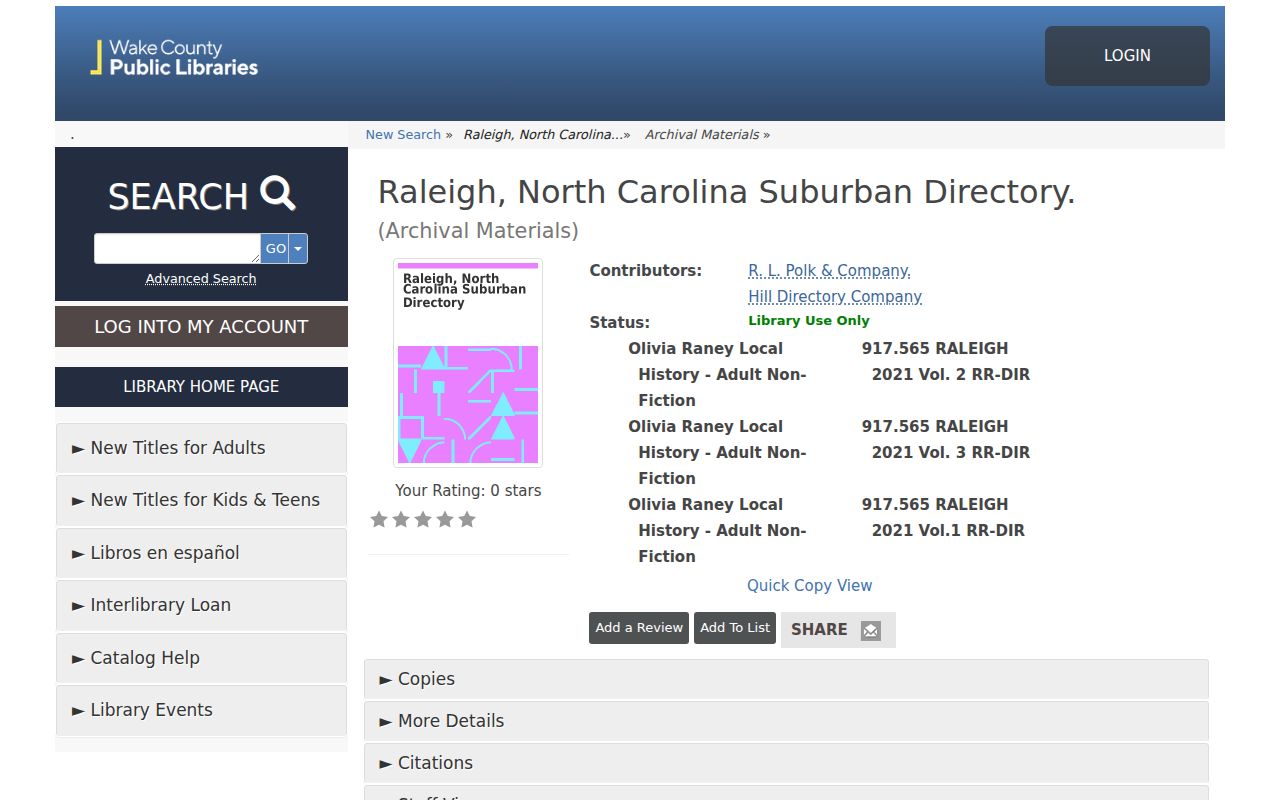
Its library location and circulation status point researchers to the physical volume rather than suggesting a complete online resident list.
Wake Forest Directory Shelf at Olivia Raney
Olivia Raney Local History is the practical access point for noncirculating directories, yearbooks, microfilm, fiche, and cataloged local-history material. The North Carolina library directory lists it at 4016 Carya Drive in Raleigh, with 919-250-1196 as the phone number. Staff can help identify the cataloged cross-reference title, locate a microfilm series, or distinguish a serial issue from a digitized item. The library’s genealogy and research-help route is also a documented way to send a focused question to staff and regional libraries.
Start a request with a surname, a street or place term, an approximate year, and the type of item needed. “Wake Forest,” “Raleigh directory,” “yearbook,” and “deeds” are useful catalog terms. A precise request works better than asking for a broad personal history, because the library can direct a searcher to a book, reel, box, or finding aid that actually exists.
Wake Forest Directory Clues Before 1975
Earlier research often begins with the Raleigh city-directory shelf. The documented holdings include editions for 1880-81, 1887, 1891, 1896-97, 1899-1900, 1907-08, 1919-20, 1923-25, 1927, 1929, 1931, 1933, and 1935-38, plus later material. Those titles focus on Raleigh. They can still be useful when a Wake Forest person attended the college, had a second address, or appeared in surrounding territory, but the city printed on a volume is not a modern corporate-limit statement.
One useful comparison is chronological rather than geographic: the Hill suburban serial is the documented direct route for post-1975 Wake Forest listings, while Raleigh volumes and online scans offer earlier context. The 1899-1900 preface says its canvass reached beyond Raleigh limits into Oberlin, Caraleigh, Pilot Mills, Brooklyn, West Raleigh, East Raleigh, Method, and tributary territory. Check the page image, the volume preface, and a dated map before assigning a historic entry to the modern town.
The Raleigh city-directory catalog record identifies the varied publishers and cross-reference titles held by the library.
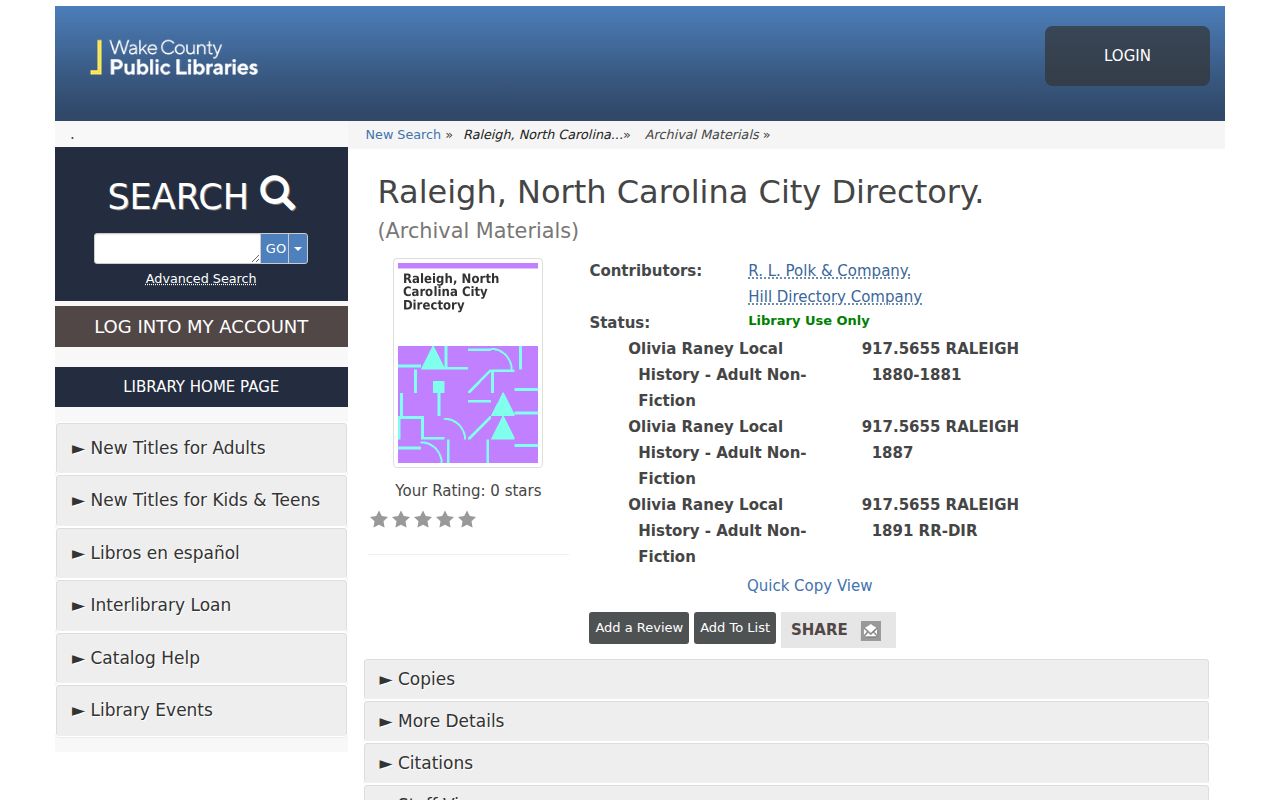
Catalog notes are the starting point for publisher and date verification, while the original directory page is the source for a name or address claim.
Wake Forest Digitized Directory Pages
The DigitalNC record for the Maloney volume provides another route into a scanned historical city directory. It identifies the collection item before the researcher moves from metadata to the original page, OCR, or PDF. That distinction is important where a surname, punctuation mark, or period abbreviation is unclear in automated text.
Digitized metadata helps establish the edition and scan source, but it does not turn an OCR result into a verified household record.
Reading a Wake Forest Directory Entry
A historical directory entry is a compact clue, not a full biography. In the digitized 1899-1900 Maloney volume, the pattern can include a name, a recorded role, a business address, the abbreviation r for residence, and a street or location. The example “Hartsfield Wm A, watchmkr 219 S Wilmington, r Oakdale ave bey limits” shows why the page image matters. “Bey limits” means beyond the city limits, and it changes how the place should be interpreted. OCR can also blur periods, initials, and abbreviations.
| Name form | Initials, surname order, and spelling as printed; preserve them for index searches. |
|---|---|
| Recorded role | A short description or business connection that can distinguish two people with the same name. |
| Business location | A separate street reference that is not automatically a home address. |
| Residence mark | r identifies residence in the cited Maloney pattern; read it with the complete line. |
| Place qualifier | Terms such as “bey limits” signal a boundary condition that needs a map and date check. |
- Criss-cross directory
- An address-first companion volume that can lead from a street to a listed name when that edition has one.
- Householder index
- An index arranged around a household or address, if the publisher included it; do not assume every volume does.
- Abbreviation key
- The publisher’s explanation of short forms. Photograph or note it before interpreting an entry.
- OCR
- Machine-read text from a scan. It is useful for discovery but should be checked against the page image.
The Internet Archive scan of Maloney’s 1899-1900 directory makes the page image available beside OCR and PDF formats.
Reading the scan preserves abbreviations and boundary wording that automated text can misread.
Wake Forest College Directory Clues
Wake Forest College yearbooks and directories offer a different kind of dated entry. Olivia Raney holds selected volumes for 1912, 1915-18, 1921-22, 1925, 1928, 1931, 1933, 1937-38, 1940-41, 1944, 1946-49, 1953, and 1976. They are library-use-only. A class year, campus organization, or faculty reference can reconnect a former classmate or campus household to a period place, but it should be confirmed against the volume page and a contemporary directory, newspaper, deed, or map.
The Wake Forest College yearbook catalog search shows the title-search route used to locate those library holdings.
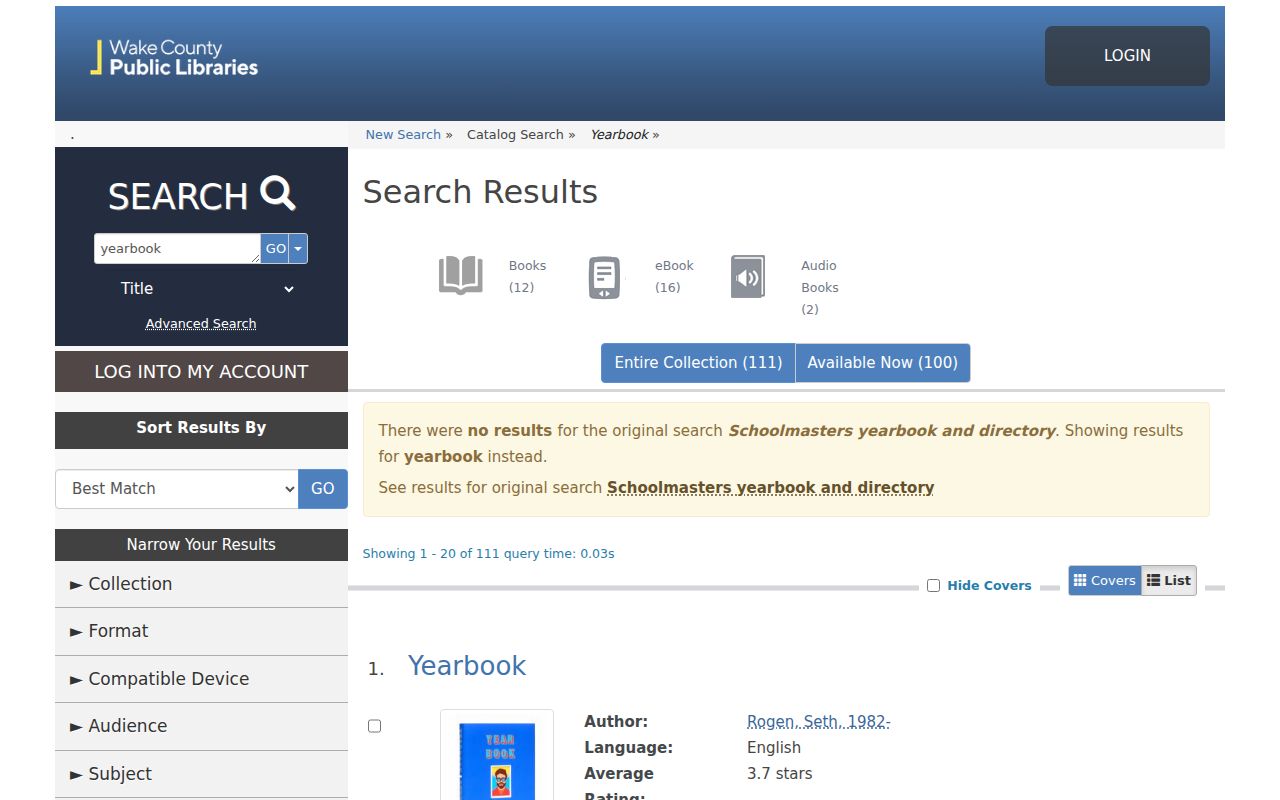
Yearbooks add a date and institutional setting to a directory lead without establishing a current address.
Royall Mills Place Names in Directories
Directory research needs an old-place-name check in the former mill village. Royall Cotton Mill was built in 1899-1900. The surrounding village was incorporated as Royall Mills in 1907, its charter was repealed in 1945, and it was annexed into Wake Forest in September 1977 after the mill closed in 1976. A directory, newspaper, or deed may therefore use “Royall Mills” where a current map uses Wake Forest. That is a local comparison between a period place name and modern jurisdiction, not evidence that an address changed on a particular day.
- 1899-1900: Royall Cotton Mill was built, creating the setting for the separate mill village.
- 1907: Royall Mills was incorporated as its own village.
- 1945: The Royall Mills charter was repealed.
- 1976-1977: The mill closed, then the village was annexed into Wake Forest in September 1977.
Search “Wake Forest College,” “Town of Wake Forest College,” “Wake Forest,” “Royall Mills,” and “Glen Royall” when the source date supports those terms. The Wake County Historical Society resource page can provide county-history leads and referrals when a directory volume is missing.
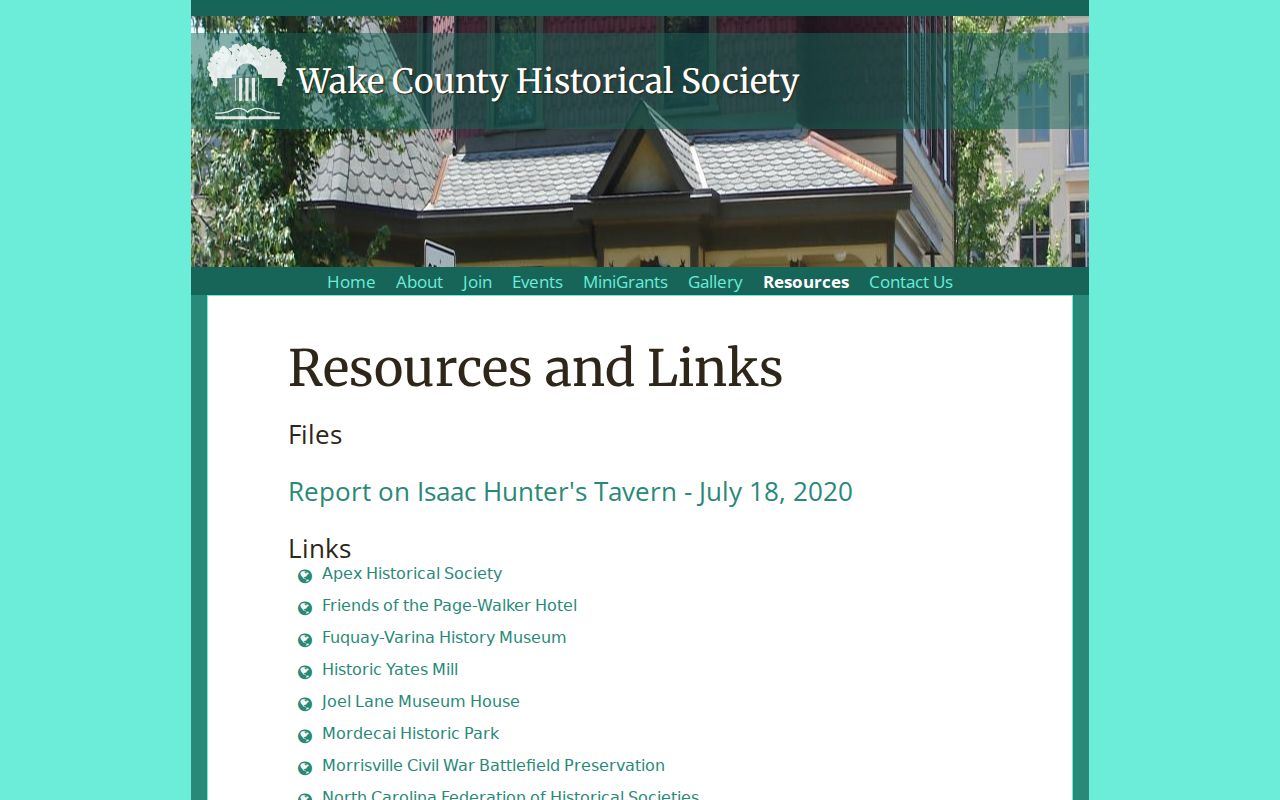
Historical-society materials can add maps, published history, and referrals that help preserve the period name attached to an entry.
Note: A historic district or landmark record supports public history research, not a reason to approach a private residence or infer a current household.
Trace a Wake Forest City Directory Household
Use a city directory trail in date order. Begin with the closest documented edition, then work in both directions. Copy the name exactly, retain initials, and capture the page reference before trying a broader search. A listed occupant and a deed owner may be different people, so pair the directory with the county property card, deed book and page, and a map rather than forcing the sources to say the same thing. The historical shelf gives household clues; the county record systems answer ownership and parcel questions.
- Search a known surname, street, or college class in the Suburban Directory and two nearby annual issues.
- Record the edition date, page, address wording, and whether the entry is an occupant, business, or telephone listing.
- For an earlier period, check Raleigh titles and ask Olivia Raney staff whether a cataloged cross-reference volume covers the address.
- Pair the directory year with a census decade, newspaper item, map, property card, or deed reference appropriate to the question.
- Use a yearbook for campus-era leads, then confirm the class year and person on the original page.
- Keep county, municipal jurisdiction, ZIP, and source date together when comparing an old listing with a current map.
When a name disappears, the directory alone cannot say why. The person may have moved, died, changed how the name was printed, been omitted, or appeared in another community. Newspapers and archival material can extend the trail, while a modern record should be used only to verify the separate question it actually answers. A name that needs current-record confirmation can be checked through the Wake Forest resident lookup route, while modern parcel work belongs with the Wake Forest street records.
Wake Forest Directory Gaps
The research found no standalone Wake Forest-only printed directory series, no complete official obituary index, and no single online reverse directory for a Wake Forest address. Those absences matter. Use the cataloged criss-cross and cross-reference titles with staff help instead of assuming a modern address search exists. For a missing name, the documented fallback is newspaper microfilm, library staff, the State Archives, the Historical Society, and the original deed or directory volume. The gap should remain a gap until a custodian identifies a real collection.
Catalog discovery and original-record review are separate steps. A catalog title can identify a publisher, date, format, and shelf location, but it does not show the full entry for a person or address. When the shelf does not hold the needed year, record that absence and move to the documented newspaper, archive, or county-record route rather than filling it with a guess.
Wake Forest Directory Archives and Newspapers
Directories are strongest when they are linked to independent historical material. The North Carolina Newspaper Project lists Wake Forest’s People’s Paper for 1895 and 1896 and Home Journal for 1885 in the located guide. The State Archives finding aids can also lead to the George W. Norwood papers, Wynne Family Papers, and Georgea White Collection, each with its own scope and access conditions. The North Carolina State Archives finding-aid service should be searched before a visit.
A newspaper notice or family paper may explain a marriage, civic event, deed, or move suggested by a city directory entry. It remains a lead to verify. The best result keeps the directory’s page citation alongside the archive collection name, newspaper date, and county record reference, rather than blending them into one unsourced claim.